Hari Raya Haji (Aidiladha) in Singapore
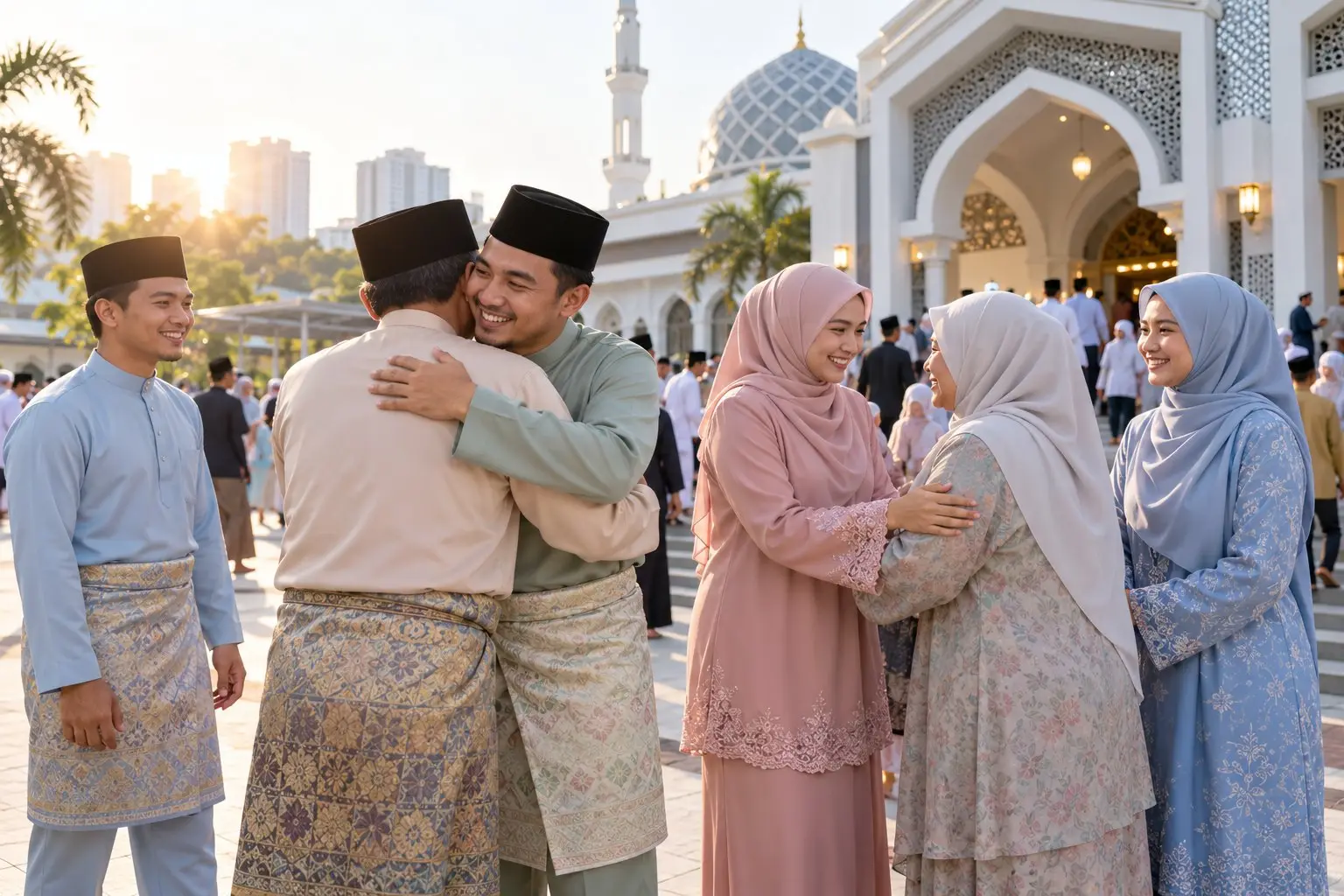
Hari Raya Haji (Aidiladha), on 10 Zulhijjah, marks the completion of the Haj and Prophet Ibrahim's sacrifice. MUIS lists it as 17 May 2027, confirmed by the Mufti nearer the time, and the day centres on the sunnah Aidiladha prayer.
On this page10 sections · tap to jump
Hari Raya Haji — Eid al-Adha, known in the Shafi’i mainstream of Singapore as Aidiladha — is the festival on 10 Zulhijjah that marks the completion of the Haj and honours Prophet Ibrahim’s willingness to sacrifice. This guide covers the practical and devotional side in Singapore: when it falls, how the sunnah Aidiladha prayer is performed, the takbir, the fasting around the day and where to pray — following MUIS and the Office of the Mufti. For the sacrifice itself, see our qurban in Singapore guide; for the other Eid, see Hari Raya Aidilfitri.
What Hari Raya Haji marks
Aidiladha falls on the tenth day of Zulhijjah, the last month of the Islamic calendar and the month of the Haj pilgrimage. It is often called the “day of sacrifice”. MuslimSG, the MUIS platform, describes it as the celebration that marks the completion of the Five Pillars of Islam through the fifth pillar, the Haj: pilgrims from every background gather in Makkah to submit wholly to Allah, and the wider community celebrates with them.
The day is tied to the story of Prophet Ibrahim (peace be upon him), who was commanded to sacrifice his son Ismail as a test of devotion. Both father and son submitted; by Allah’s mercy, Ismail was ransomed and an animal was sacrificed instead. That act is the origin of qurban (korban), the annual sacrifice. Aidiladha is also the last of the ten best days of Zulhijjah, in which, by hadith, good deeds are especially beloved to Allah.
When it falls in Singapore
Because the Islamic calendar is lunar, the Gregorian date shifts about eleven days earlier each year, and the start of each month is confirmed by the Mufti of Singapore near the time. MUIS publishes the anticipated dates ahead in its Islamic calendar.
For 1448H / 2027, MUIS lists Hari Raya Aidiladha (10 Zulhijjah 1448H) as 17 May 2027, a Monday — 1 Zulhijjah falls on 8 May 2027. In 2026 it fell on 27 May. It is a gazetted public holiday in Singapore.
Aidiladha or Aidilfitri?
The two Hari Raya are different festivals. Aidilfitri (Hari Raya Puasa) falls on 1 Syawal and closes the fasting month of Ramadan. Aidiladha (Hari Raya Haji) falls on 10 Zulhijjah and is tied to the Haj and qurban. In many Muslim communities Aidiladha is regarded as the “bigger” Eid, though in Singapore Aidilfitri is the more visibly celebrated of the two. The forms of worship also differ: the fasting that precedes each, the length of the takbir window, and the qurban that follows Aidiladha.
The Aidiladha prayer, step by step
The sunnah Aidiladha prayer (Solat Aidiladha) is, like the Aidilfitri prayer, one of the most highly recommended sunnah prayers — sunnah muakkadah, strongly encouraged but not obligatory (wajib). Its window is on 10 Zulhijjah, from when the sun has fully risen (about 30 minutes after Syuruq, roughly 7:20am) until the azan of Zohor; once Zohor enters, it can no longer be performed.
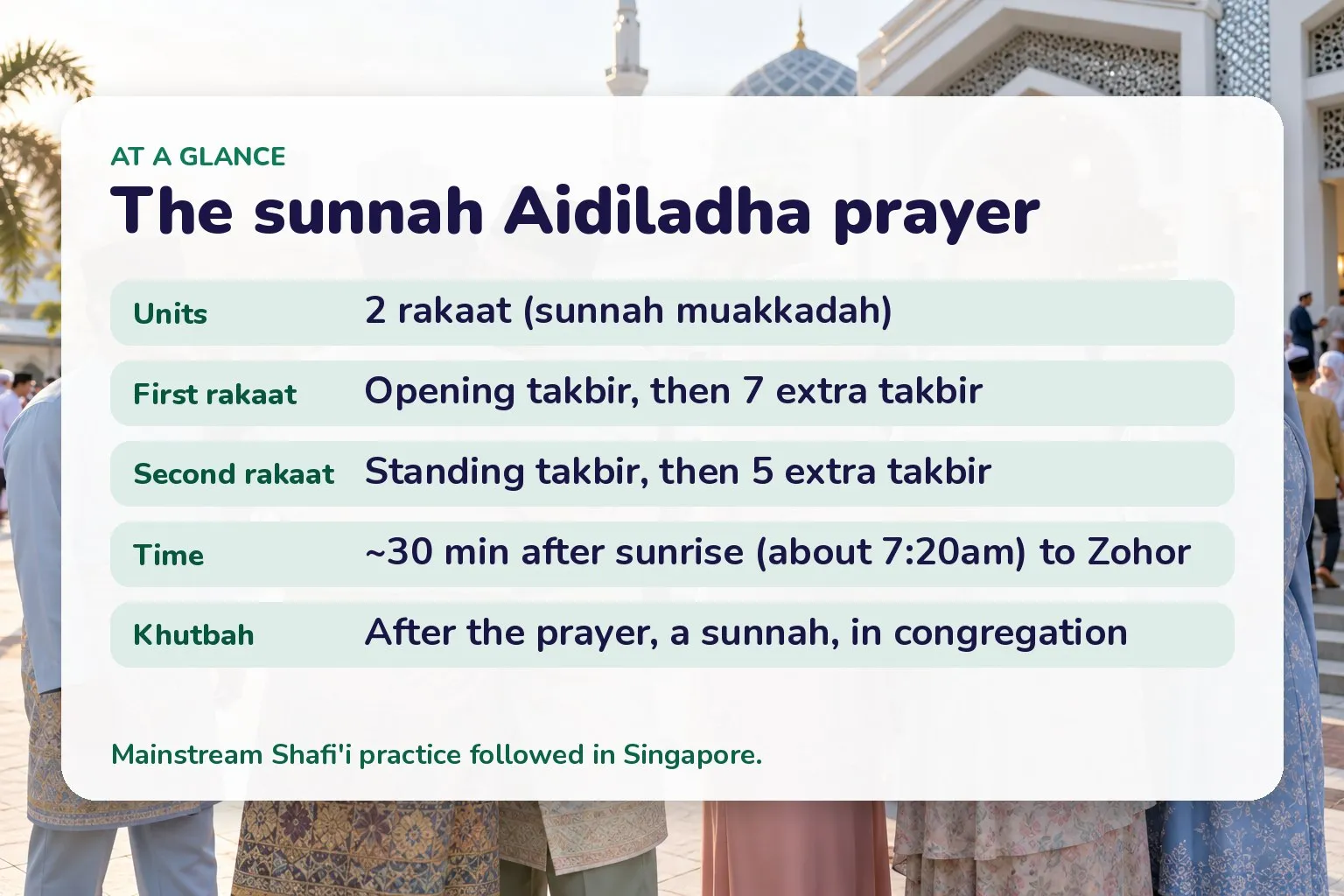
How the Aidiladha prayer is performed.
It is a two-rakaat prayer with extra takbir:
- Intention and takbiratul ihram. Make the intention for the sunnah Aidiladha prayer, then the opening takbir (“Allahu Akbar”).
- Dua Iftitah, recited quietly (first rakaat only).
- Seven extra takbir in the first rakaat, with a short tasbih between each. These seven are separate from the opening takbiratul ihram.
- Al-Fatihah and another surah, then complete the rakaat (ruku’, i’tidal, two sujud).
- Second rakaat: stand, then five extra takbir, followed by Al-Fatihah and a surah, and complete the rakaat.
- Final tasyahhud and salam.
The khutbah (sermon) follows the prayer. Unlike the Friday prayer, it is not an integral (rukun) of the Eid prayer — it is a sunnah performed in congregation, so no khutbah is needed when you pray at home. If you cannot reach a mosque — a caregiving duty, a work commitment — you may perform the prayer individually or with your family at home, any time up to Zohor.
The takbir: from Arafah to the Tasyrik days
Reciting the takbir on both Eids is a sunnah and a syiar (visible symbol) of Islam, an expression of gratitude. For Aidiladha the window is longer than for Aidilfitri. After weighing the scholarly views, the Office of the Mufti holds that the Aidiladha takbir should begin at Subuh on the Day of Arafah (9 Zulhijjah) and continue until Asar on the third Tasyrik day (13 Zulhijjah).
In practice that means you may recite the takbir after each of the five daily prayers across those days, as well as freely in between — in 2027, from the dawn of Sunday 16 May through the afternoon of Thursday 20 May, bracketing the festival itself.
Fasting around the day
The first ten days of Zulhijjah are a season of worship. For those not performing the Haj, fasting on the Day of Arafah (9 Zulhijjah, the eve of Hari Raya Haji) is strongly encouraged; a hadith reported by Imam Muslim describes it as expiating the sins of the past and the coming year. Many also fast some or all of the first nine days.
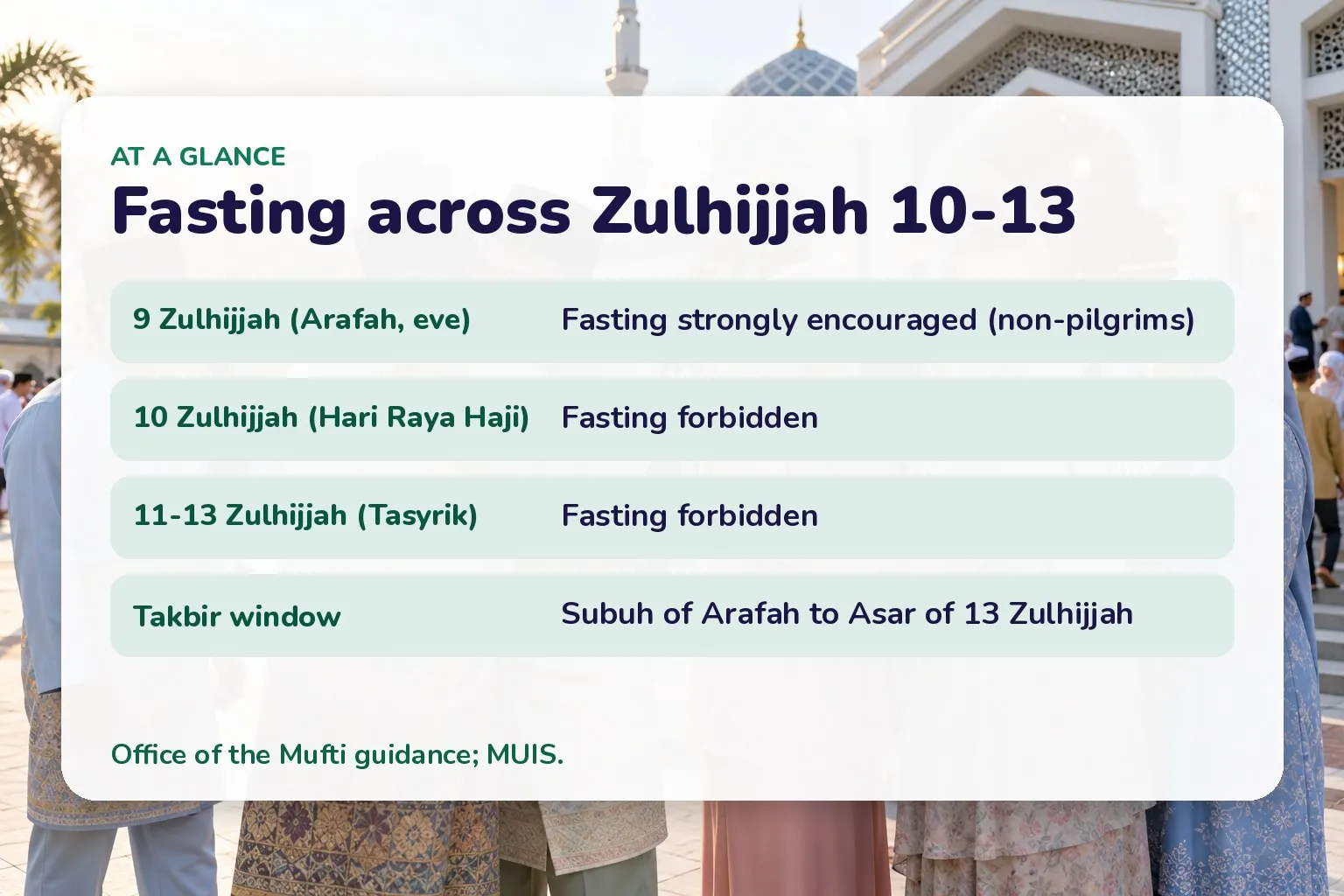
When to fast and when not to around Hari Raya Haji.
On the day itself, the rule reverses. Fasting on Hari Raya Haji (10 Zulhijjah) is not allowed, and fasting is forbidden on the three Tasyrik days (11–13 Zulhijjah) that follow — these are days of eating, remembrance and sharing the qurban meat.
Praying at a mosque: spaces and booking
Singapore’s mosques organise the Aidiladha prayer in congregation with several sessions. As a guide to scale, for Aidiladha 2026 mosques provided about 240,000 prayer spaces across up to three sessions, including dedicated spaces for female congregants, plus about 20,300 more at up to 44 supplementary venues (almost 10% more than the year before) aimed at elderly congregants and those with mobility needs.
Booking was not required that year except for Session 1 at Masjid Darul Ghufran. MUIS encourages congregants with flexibility to choose the second or third session, which are less crowded and easier for families with young children and the elderly.
Exact timings, session details and any booking rules are published by MUIS closer to the date each year, so confirm the current year’s arrangements at the links above rather than assuming last year’s setup.
Qurban on the day
The sacrifice that gives the festival its name is qurban (korban) — the slaughter of a qualifying livestock animal on Hari Raya Haji and the Tasyrik days, the meat shared with family, relatives and the needy. In Singapore it runs mainly through MUIS’s SalamSG Korban at participating mosques, as an overseas or local korban and as a whole animal or a share. Because the ruling, timing, qualifying animals, pricing and how to register are involved, we cover them separately in the qurban in Singapore guide.
Customs and sunnah acts
On the morning of Hari Raya Haji, Muslims gather at mosques for the congregational prayer, then greet one another to brighten the occasion. It is encouraged to take a different route to and from the mosque so you meet and greet more people along the way. As with the other Eid, the spirit is gratitude — for the completion of the Haj season, for the ability to give, and for the chance to strengthen family and community bonds. For how the related giving acts work, see our guides on qurban and Ramadan in Singapore.
Frequently asked questions
Is Hari Raya Haji the same as Hari Raya Puasa? No. Hari Raya Puasa (Aidilfitri) ends Ramadan on 1 Syawal; Hari Raya Haji (Aidiladha) is on 10 Zulhijjah and is tied to the Haj and qurban.
When is Hari Raya Haji 2027? MUIS lists it as 17 May 2027 (10 Zulhijjah 1448H), confirmed by the Mufti nearer the time.
Can I fast on Hari Raya Haji? No. Fasting on 10 Zulhijjah and the three Tasyrik days (11–13 Zulhijjah) is forbidden; the encouraged fast is on the eve, the Day of Arafah.
Do I need to book a mosque space? Usually no, but specific sessions at some mosques may require booking — check the current year’s arrangements at go.gov.sg/rayaprayer.
Is the khutbah compulsory? No. The Eid khutbah is a sunnah performed in congregation and is not an integral of the prayer; it is not needed when praying at home.
Sources
- Prayer arrangement for Hari Raya Aidiladha 2026/1447H — Majlis Ugama Islam Singapura (MUIS) (as of 20 May 2026)
- How to perform Aidiladha prayer — MuslimSG (MUIS / Asatizah Youth Network) (as of October 2026)
- The true meaning of Hari Raya Haji — MuslimSG (MUIS / Asatizah Youth Network) (as of October 2026)
- Guidance for Eiduladha takbir (irsyad) — Office of the Mufti, Majlis Ugama Islam Singapura (MUIS) (as of 21 February 2025)
- Islamic calendar — Key Islamic dates 2027 (1448H) — Majlis Ugama Islam Singapura (MUIS) (as of 24 September 2026)