Hari Raya Aidilfitri in Singapore
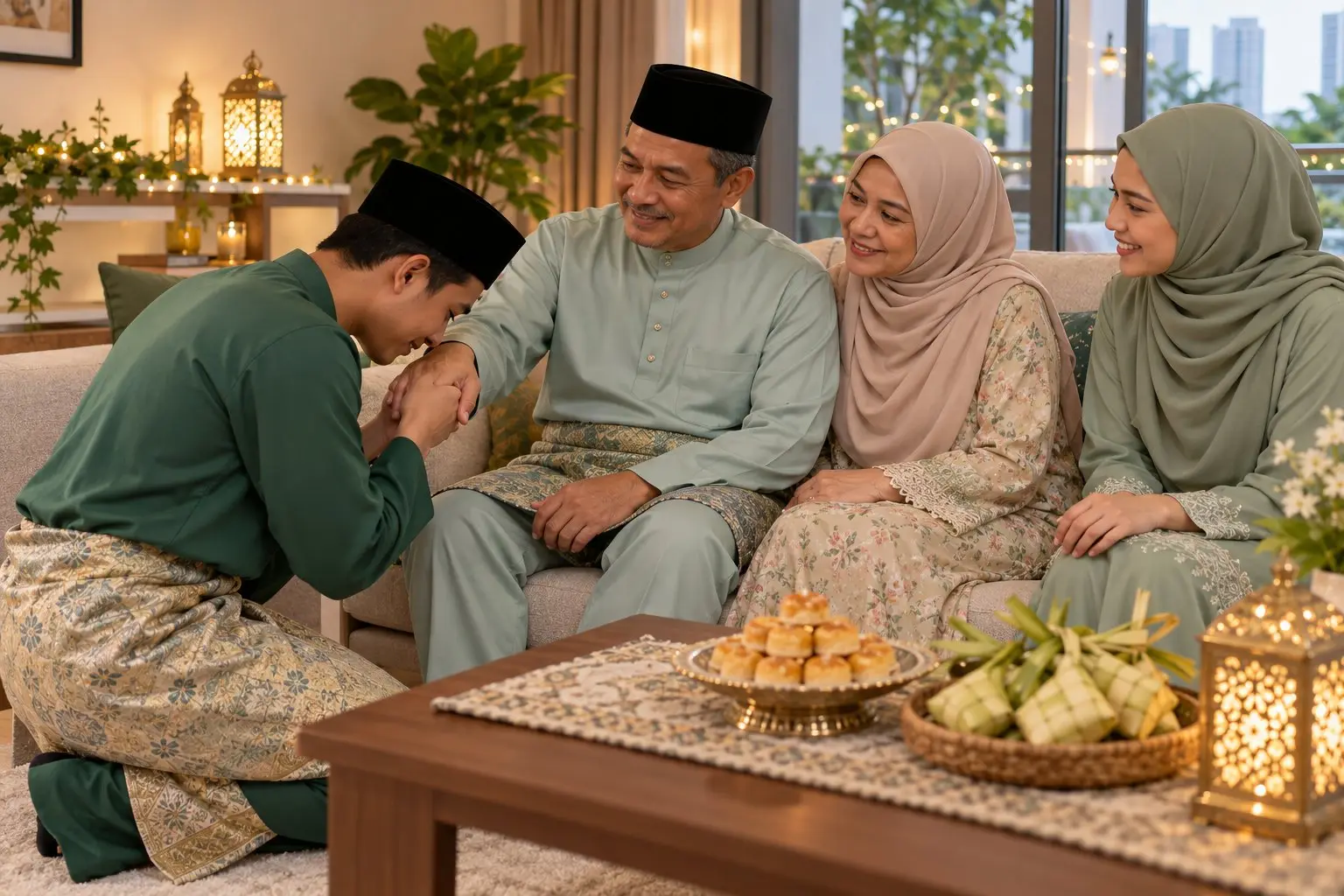
Hari Raya Aidilfitri, the first day of Syawal, marks the end of Ramadan's fasting. MUIS lists it as 10 March 2027, confirmed by the Mufti nearer the time, and the day centres on the sunnah Aidilfitri prayer.
On this page10 sections · tap to jump
- 01What Hari Raya Aidilfitri marks
- 02When it falls in Singapore
- 03Aidilfitri or Aidiladha?
- 04The night before: takbir
- 05The Aidilfitri prayer, step by step
- 06Praying at a mosque: spaces and booking
- 07The sunnah acts of Eid
- 08Before the day: settle zakat fitrah
- 09Customs in Singapore
- 10Frequently asked questions
Hari Raya Aidilfitri — Eid al-Fitr, known locally as Hari Raya Puasa — is the day that closes the fasting month of Ramadan. This guide covers the practical and devotional side in Singapore: when it falls, how the sunnah Aidilfitri prayer is performed, where to pray, the sunnah acts of the day and the local customs — following MUIS guidance and the mainstream Shafi’i practice. For the fasting month itself, see our Ramadan in Singapore guide.
What Hari Raya Aidilfitri marks
Aidilfitri falls on the first day of Syawal, the tenth month of the Islamic calendar, immediately after Ramadan. Hari raya is Malay for “big day of rejoicing”, and the festival marks the end of a month of fasting with prayer, forgiveness and the strengthening of family ties. It is not the Islamic New Year, which is a separate occasion.
When it falls in Singapore
Because the Islamic calendar is lunar, the Gregorian date shifts by about eleven days earlier each year, and the start of Syawal is declared by the Mufti of Singapore close to the date. MUIS publishes the anticipated dates ahead of time in its Islamic calendar.
For 1448H / 2027, MUIS lists Hari Raya Aidilfitri as 10 March 2027. It is a gazetted public holiday in Singapore.
Aidilfitri or Aidiladha?
Singapore has two Hari Raya holidays, and it helps to keep them apart:
- Hari Raya Aidilfitri (Hari Raya Puasa) — 1 Syawal, the end of Ramadan. This is the one most people mean by “Hari Raya”.
- Hari Raya Aidiladha (Hari Raya Haji) — 10 Zulhijjah, the festival of sacrifice at the close of the Hajj. In 2026 it fell on 27 May.
Both have a two-rakaat sunnah Eid prayer, but they are different festivals about two and a half months apart.
The night before: takbir
The celebration begins on the eve. Takbir — the words Allaahu akbar, Allaahu akbar, Allaahu akbar, laa ilaaha illallah, Allaahu akbar, Allaahu akbar, wa Lillaahil-hamd (“Allah is Most Great… there is no god except Allah… and all praise be to Allah”) — is recited from after Maghrib on the eve of Aidilfitri until the imam begins the Eid prayer the next morning. If you attend a later prayer session, you may recite it until the imam starts that session. Reciting takbir is itself a sunnah of the day.
The Aidilfitri prayer, step by step
The sunnah Aidilfitri prayer (Solat Raya) is one of the most highly recommended of the voluntary prayers (sunnah muakkadah). It is two rakaat, and what makes it distinctive is a set of extra takbir before the Quran is recited. This is the mainstream Shafi’i practice followed in Singapore.
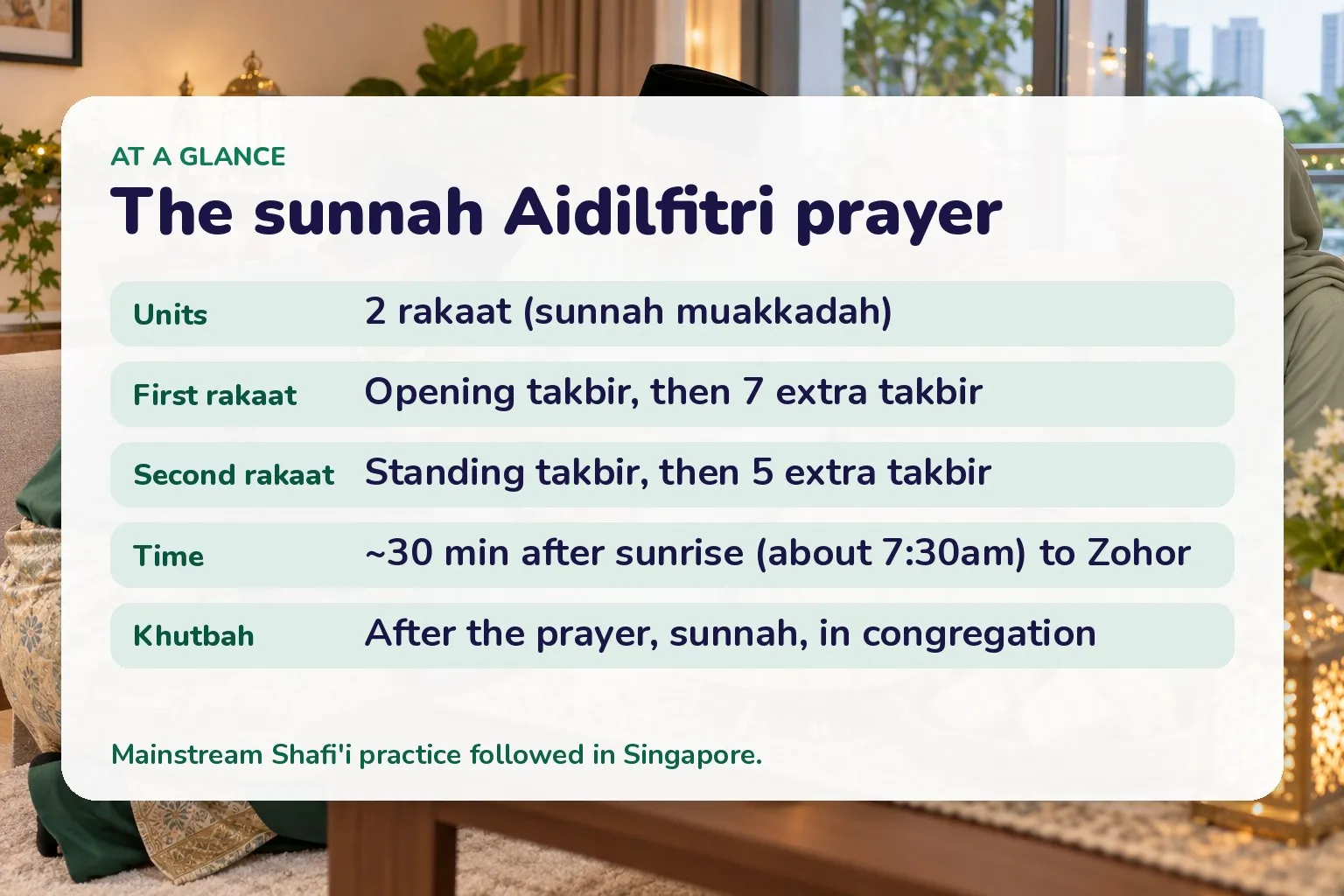
How the Aidilfitri prayer is performed.
- Intention and the opening takbir. Make the intention for the sunnah Aidilfitri prayer, then begin with the opening takbiratul ihram as in any prayer.
- Seven takbir in the first rakaat. After the opening supplication, raise your hands for seven additional takbir, with a short glorification (tasbih) between each, then recite Al-Fatihah and a surah.
- Five takbir in the second rakaat. After standing for the second rakaat, give five additional takbir (again separate from the standing takbir), then complete the rakaat as usual.
- The khutbah. In congregation, a khutbah (sermon) follows the prayer. Unlike the Friday prayer, the khutbah here is a sunnah, not an integral of the prayer, and is only for those praying in congregation — so it is not needed if you pray at home.
The window for the prayer runs from after sunrise — about 30 minutes after syuruq, roughly 7:30am — until the sun passes its zenith (the start of Zohor). If you pray at home, you may do so any time within that window.
Praying at a mosque: spaces and booking
About 69 mosques across Singapore hold the Aidilfitri prayer in congregation, with varying sessions, timings and khutbah languages. MUIS and the mosques scale up capacity sharply for the day: for Aidilfitri 2026, mosques provided roughly 240,000 prayer spaces across up to three sessions, including dedicated spaces for female congregants, plus 24,000 more at up to 49 supplementary venues (almost 30% more supplementary capacity than the year before) aimed at elderly congregants and those needing easier access.
For 2026, booking was not required except for Session 1 at Masjid Darul Ghufran (via book.masjids.sg). MUIS gathers the arrangements each year at go.gov.sg/rayaprayer and a venue map at maps.gov.sg/raya-prayer.
The sunnah acts of Eid
Beyond the prayer, MUIS sets out six recommended sunnahs of Eid:
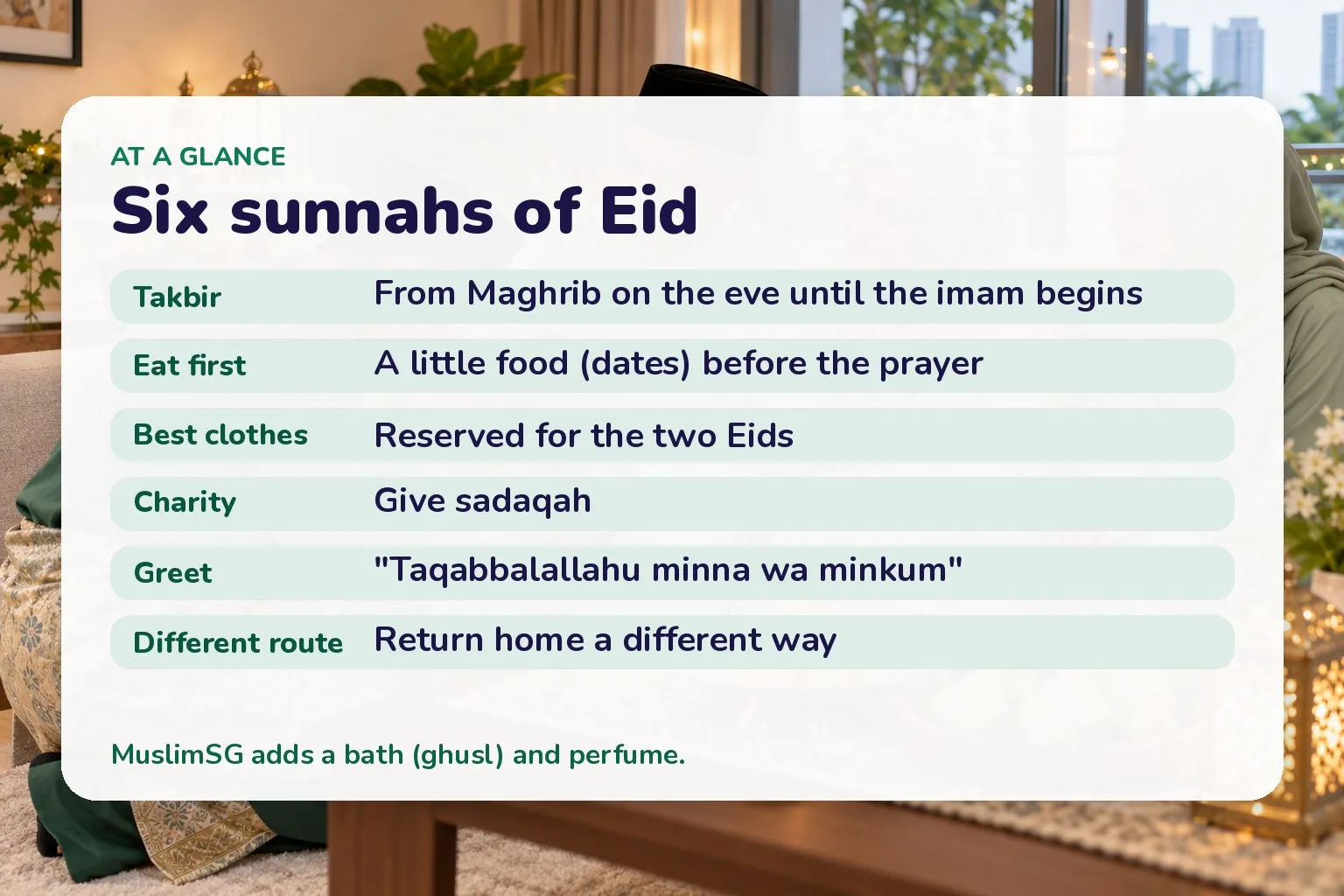
MUIS’s recommended sunnahs on the day of Eid.
- Recite takbir from Maghrib on the eve until the imam begins the prayer.
- Eat something before leaving for the prayer — the Prophet ﷺ would eat dates first, signalling that the fast is over.
- Wear your best clothes — the Prophet ﷺ reserved his best for the two Eids. Many in Singapore wear the baju kurung and baju melayu.
- Give charity (sadaqah).
- Congratulate others with “taqabbalallahu minna wa minkum” (“May Allah accept [good deeds] from us and from you”).
- Return home by a different route from the one you came by, as the Prophet ﷺ did.
MuslimSG adds further sunnah acts, including taking a bath (ghusl) — in the dominant Shafi’i view, valid from midnight on the eve — and wearing perfume.
Before the day: settle zakat fitrah
Zakat fitrah must be paid before the Eid prayer. By the eve of Hari Raya, many have already paid at authorised collection centres, mostly mosques. The amount is set each year by MUIS; see our zakat fitrah guide and the Ramadan timetable for the current figures and dates.
Customs in Singapore
Aidilfitri is, above all, a time of forgiveness and reconnection. Visiting typically begins at the parents’ home, where it is customary to ask forgiveness from parents and elders for the past year. Many families also visit the cemetery to remember those who have passed, though this is a custom rather than a requirement.
Homes are opened to relatives and friends, and the table carries dishes such as beef rendang, ketupat and lontong, with cookies and pineapple tarts. Where homes once glowed with lampu colok oil lamps, decorative lights are now the norm. When Hari Raya and other festivals have coincided, Singaporeans have even coined shared terms like Gongxi Raya and Deepa Raya — a reflection of the country’s mixed calendar of celebrations.
For a question about your personal situation — for example how to perform the prayer with a medical condition — the Office of the Mufti can advise.
Frequently asked questions
Is the Aidilfitri prayer compulsory? No — it is a highly recommended sunnah (sunnah muakkadah), not an obligation like the five daily prayers. The Prophet ﷺ never missed it.
Do I need to book a place at the mosque? Usually not. For Aidilfitri 2026, booking was required only for Session 1 at Masjid Darul Ghufran; every other mosque and session was walk-in. Arrangements change yearly, so check go.gov.sg/rayaprayer before the day.
Can women attend the mosque prayer? Yes. Mosques set aside dedicated spaces for female congregants. A woman who is menstruating does not pray but may still listen to the khutbah, including from home.
What if I cannot get to a mosque? You may perform the two-rakaat sunnah prayer at home, alone, any time within the window (from about 30 minutes after sunrise until Zohor). The khutbah is not needed at home.
Related
Sources
- Religious guidance on performing Eid prayer in Singapore (irsyad) — Majlis Ugama Islam Singapura (MUIS) (as of October 2026)
- How to perform Aidilfitri prayer — step by step guide — MuslimSG (MUIS / Asatizah Youth Network) (as of October 2026)
- Sunnah acts of Hari Raya Aidilfitri — MuslimSG (MUIS / Asatizah Youth Network) (as of October 2026)
- Prayer arrangement for Hari Raya Aidilfitri prayer 2026/1447H — Majlis Ugama Islam Singapura (MUIS) (as of 13 March 2026)
- Islamic calendar — Key Islamic dates 2027 (1448H) — Majlis Ugama Islam Singapura (MUIS) (as of 24 September 2026)
- Hari Raya Puasa (festival, customs and history) — National Library Board (Infopedia) (as of October 2026)