Hajj in Singapore: How the Process Works
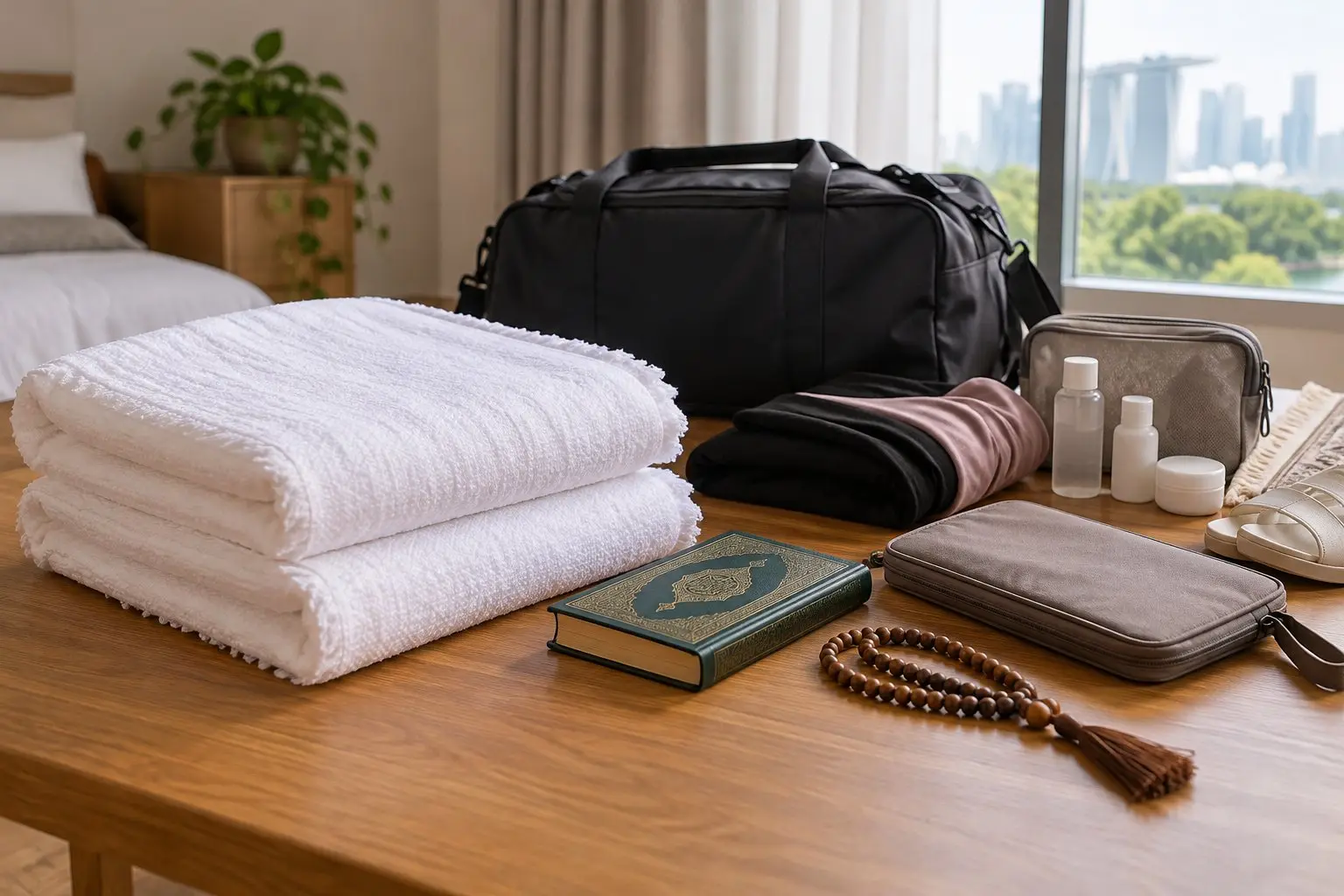
Singaporeans register for Hajj on MUIS's MyHajSG portal and join a queue for a national quota of just 900 places a year. Places are offered first-come, first-served, with seniors aged 70 and above prioritised, so the wait now runs beyond a decade.
On this page10 sections · tap to jump
- 01How Hajj is organised in Singapore
- 02The 900-place quota
- 03Step 1: Register on MyHajSG
- 04How places are allocated: Letter of Intent, then Letter of Offer
- 05Step 2: The medical health certificate
- 06Step 3: Buy a package from a MUIS-authorised agent
- 07The waiting list, and why there are no appeals
- 08Deferring, cancelling and refunds
- 09Watch out: unlicensed agents and invalid visas
- 10Hajj versus umrah for Singaporeans
For Singaporeans, the Hajj is first an administrative journey managed by MUIS: you register on a national portal, join a queue for a very small annual quota, and are offered a place in turn. This page sets out how that process works — registration, the quota, how places are allocated, the medical requirement and the authorised travel agents — following MUIS, which administers the Hajj for Singapore. How the rites themselves are performed is a separate religious matter on which the Office of the Mufti advises.
How Hajj is organised in Singapore
The Hajj is the fifth pillar of Islam, a once-in-a-lifetime obligation on every able Muslim who has the means and a safe way to go. In Singapore it is not something you simply book with a travel agent — unlike umrah. The Islamic Religious Council of Singapore (MUIS) administers the country’s Hajj quota through the MyHajSG portal queue system, and its Haj Office allocates places, appoints the travel agents, runs medical services in the Holy Land through the Singapore Pilgrims’ Affairs Office, and coordinates the Hajj visa with the Saudi authorities.
The 900-place quota
Singapore’s official Hajj quota is 900 places a year, set at 0.1% of the Muslim population under a formula the Organisation of Islamic Conference established in 1987. The final number each year depends on the allotment granted by the Kingdom of Saudi Arabia, and MUIS has publicly asked Saudi Arabia for more places.
That small quota against a large community is the whole reason there is a queue. For Haj 2026, MUIS allocated all 900 places — and noted that about 65,000 applicants are still waiting their turn.
Step 1: Register on MyHajSG
To join the queue you register on the MyHajSG portal (haj.muis.gov.sg). Registration fixes your place in line by date and time, so the single most useful thing you can do is register early. Two things to know going in:
- Registrations are non-transferable — you cannot pass your place to someone else.
- Registration fees are non-refundable for registrations made from 21 February 2023 onwards.
The Hajj application fee has risen over time: it was S$240 in 2023, S$285 from January 2024 to December 2025, and S$330 from 1 January 2026 (before GST).
How places are allocated: Letter of Intent, then Letter of Offer
Allocation runs in two stages, and the priority differs at each.
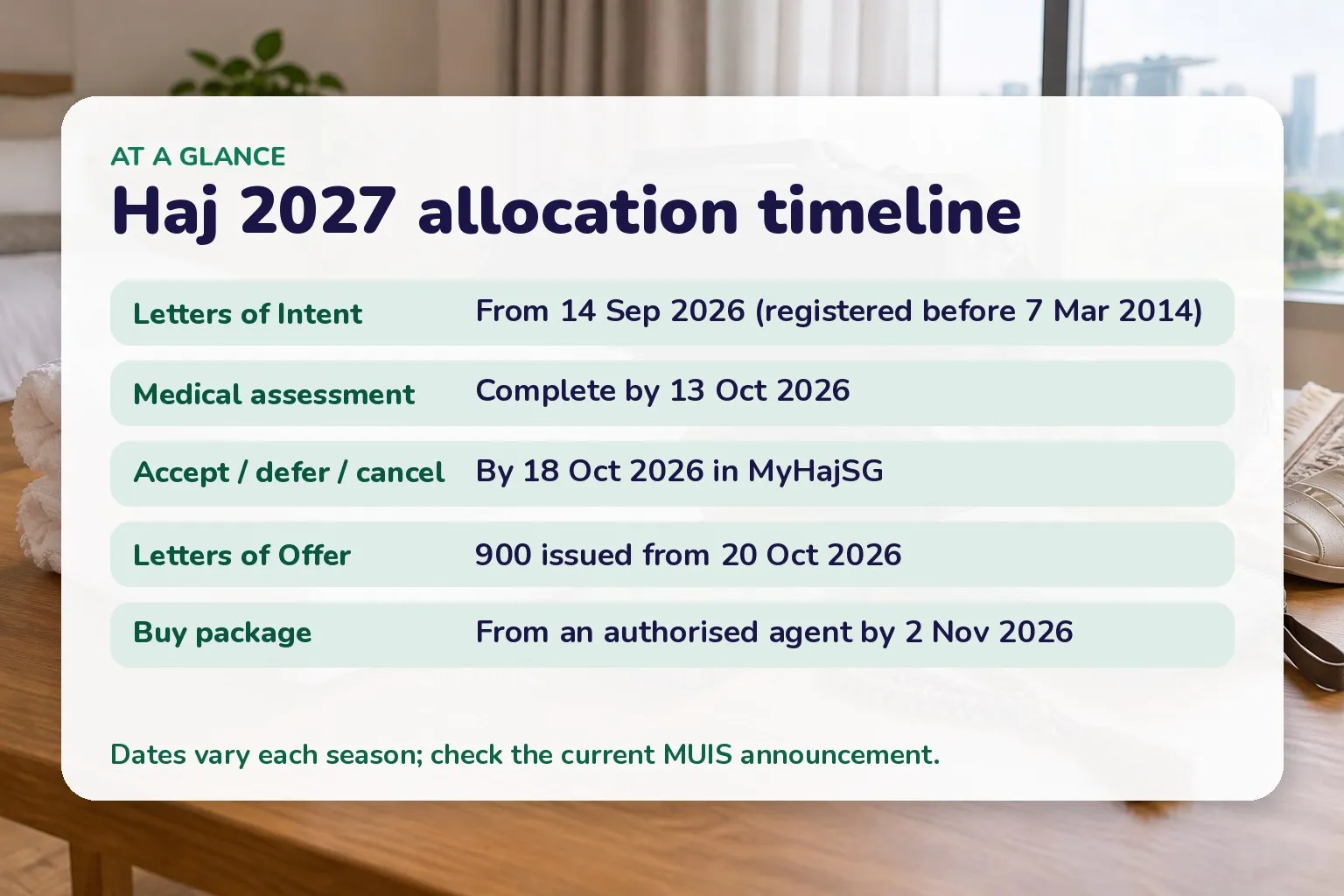
The Haj 2027 (1448H) schedule, stage by stage.
- Letter of Intent (LOI). For each season MUIS works down the registration list — earliest to latest — and issues LOIs. It deliberately issues more LOIs than the 900 places, to allow for people who later withdraw, defer or are found medically unfit. Applicants with an approved deferment to the current season are considered first.
- Letter of Offer (LOO). Among those who accept the LOI and pass the medical check, MUIS issues the 900 Letters of Offer. Here applicants aged 70 and above get priority; everyone else is considered by registration date. For Haj 2026, 12% of places went to seniors aged 70+, up five percentage points from 2025.
An LOO is the formal invitation to perform the Hajj that year. You confirm your place by purchasing a package from an authorised agent within the deadline.
Step 2: The medical health certificate
From 2026, the Saudi Ministry of Hajj and Umrah (MOHU) requires every pilgrim to hold a valid Medical Health Certificate confirming they are medically fit, free of the disqualifying chronic conditions, and physically able to perform the rites safely. A Hajj visa will not be issued without it.
In practice, once you accept the LOI you book a Haj Medical Assessment with a MUIS-appointed provider and bear the cost yourself. For Haj 2027 the fees were S$125.35 at SATA CommHealth and S$348.80 at HMI Medical Centre. The doctor submits the result to MUIS directly.
Step 3: Buy a package from a MUIS-authorised agent
Once you receive a Letter of Offer, you confirm your place by buying a Hajj package from a MUIS-authorised travel agent through MyHajSG. For Haj 2026, MUIS appointed nine travel agents offering 25 approved packages:
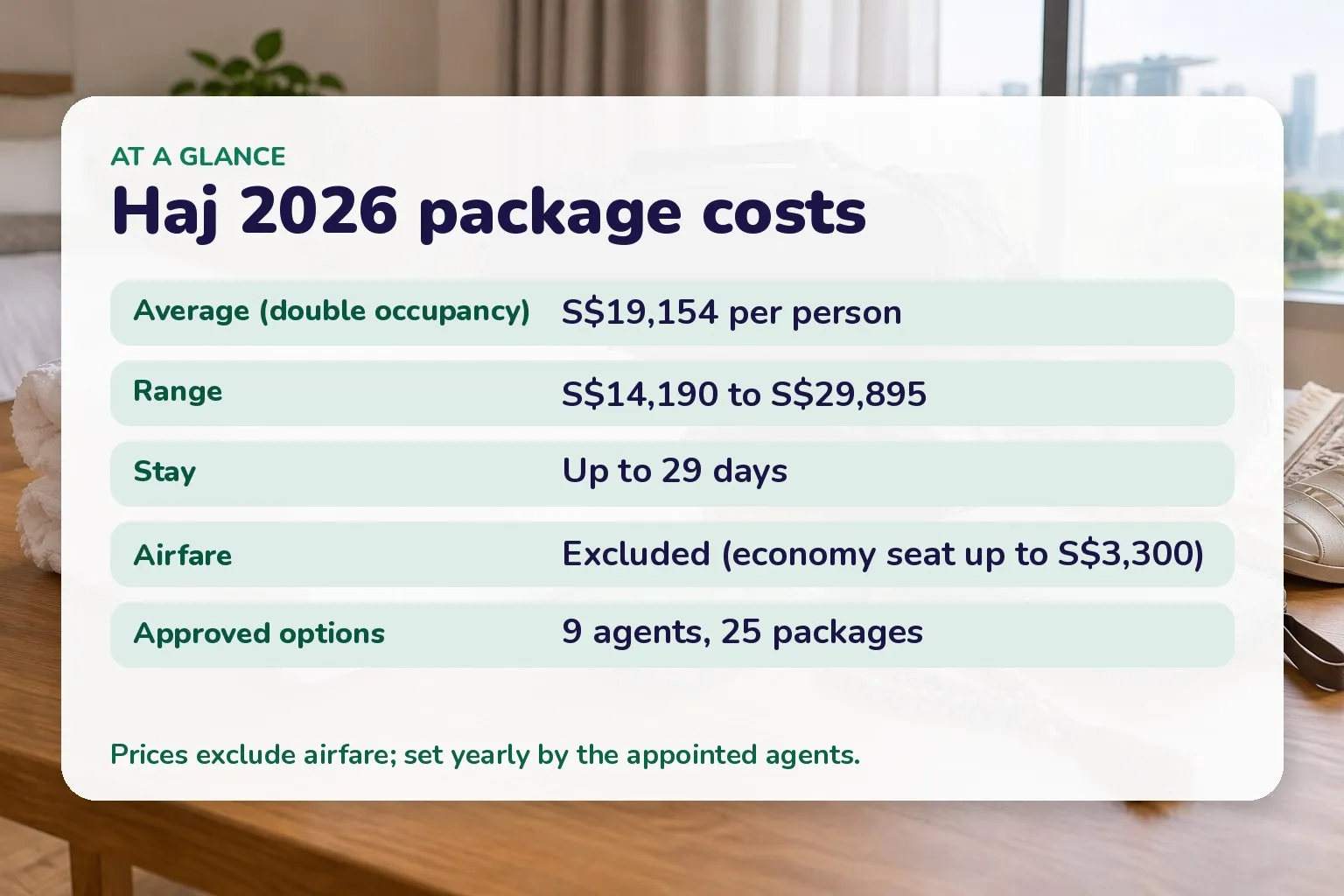
Haj 2026 (1447H) approved package prices.
- The average double-occupancy package was S$19,154 per person — up S$2,976 (about 18%) on the previous year’s S$16,178, driven by higher accommodation and Mashaer costs.
- Packages ranged from about S$14,190 to S$29,895, for stays of up to 29 days.
- Prices exclude airfare but include Mashaer services (the on-ground arrangements in Mina, Arafah and Muzdalifah), AMTAS emergency medical assistance and SPAO mobile medical services. A typical economy seat was up to S$3,300.
Before paying, read the Haj Package Purchase Contract (HPPC); agents are required to explain its key terms. MUIS also runs preparation programmes — including Get Fit for Haj and a pre-departure briefing — to ready pilgrims physically, mentally and spiritually.
The waiting list, and why there are no appeals
Eligible applicants who are not allocated a place because the quota is full go onto the waiting list. If a place frees up — through a cancellation, withdrawal or deferment — the next eligible person in line is contacted, up to the closing date for Hajj visa processing (for Haj 2026, that was 20 March 2026).
To keep the process fair, MUIS does not accept appeals or any request to be bumped up or allocated early, through any channel. No one is given priority outside the published order.
Deferring, cancelling and refunds
If you receive an offer but cannot go, you can defer or cancel in MyHajSG. The portal allows only one deferment; a further deferment must be requested by email to the Haj Office. Someone assessed medically unfit is advised to defer until their health improves. Registration fees paid from 21 February 2023 are non-refundable, though applicants who registered before that date can request a refund or donate it to Baitulmal.
Watch out: unlicensed agents and invalid visas
All Hajj services in Singapore must come only through MUIS-authorised travel agents. MUIS repeatedly warns the public against unlicensed or unauthorised agents, which can leave you with invalid arrangements, financial loss or deportation.
Hajj versus umrah for Singaporeans
The two pilgrimages are organised very differently. Umrah can be done at most times of year and needs no MUIS allocation or quota — you arrange it yourself or through a licensed agent, as set out in our umrah visa and requirements guide and how to choose an umrah package. The Hajj is once a year, capped at Singapore’s quota, and routed entirely through MUIS and its authorised agents. For a question about your personal obligation or situation, the Office of the Mufti can advise.
Related
Sources
- Haj — General information (quota and allocation process) — Majlis Ugama Islam Singapura (MUIS) (as of October 2026)
- Haj 2027 / 1448H — key dates and medical requirements — Majlis Ugama Islam Singapura (MUIS) (as of October 2026)
- MUIS allocates all 900 Haj 2026 (1447H) places to eligible pilgrims — Majlis Ugama Islam Singapura (MUIS) (as of 29 December 2025)
- Authorised travel agents and approved packages for Haj 2026 (1447H) — Majlis Ugama Islam Singapura (MUIS) (as of 27 November 2025)
- Singapore's Haj arrangements (quota, queue, health requirements) — Ministry of Culture, Community & Youth (MCCY) (as of 14 January 2026)
- Singapore allocated 900 places for Haj 1444H (application fee schedule) — Majlis Ugama Islam Singapura (MUIS) (as of October 2026)