Muslim Marriage in Singapore: ROMM Explained
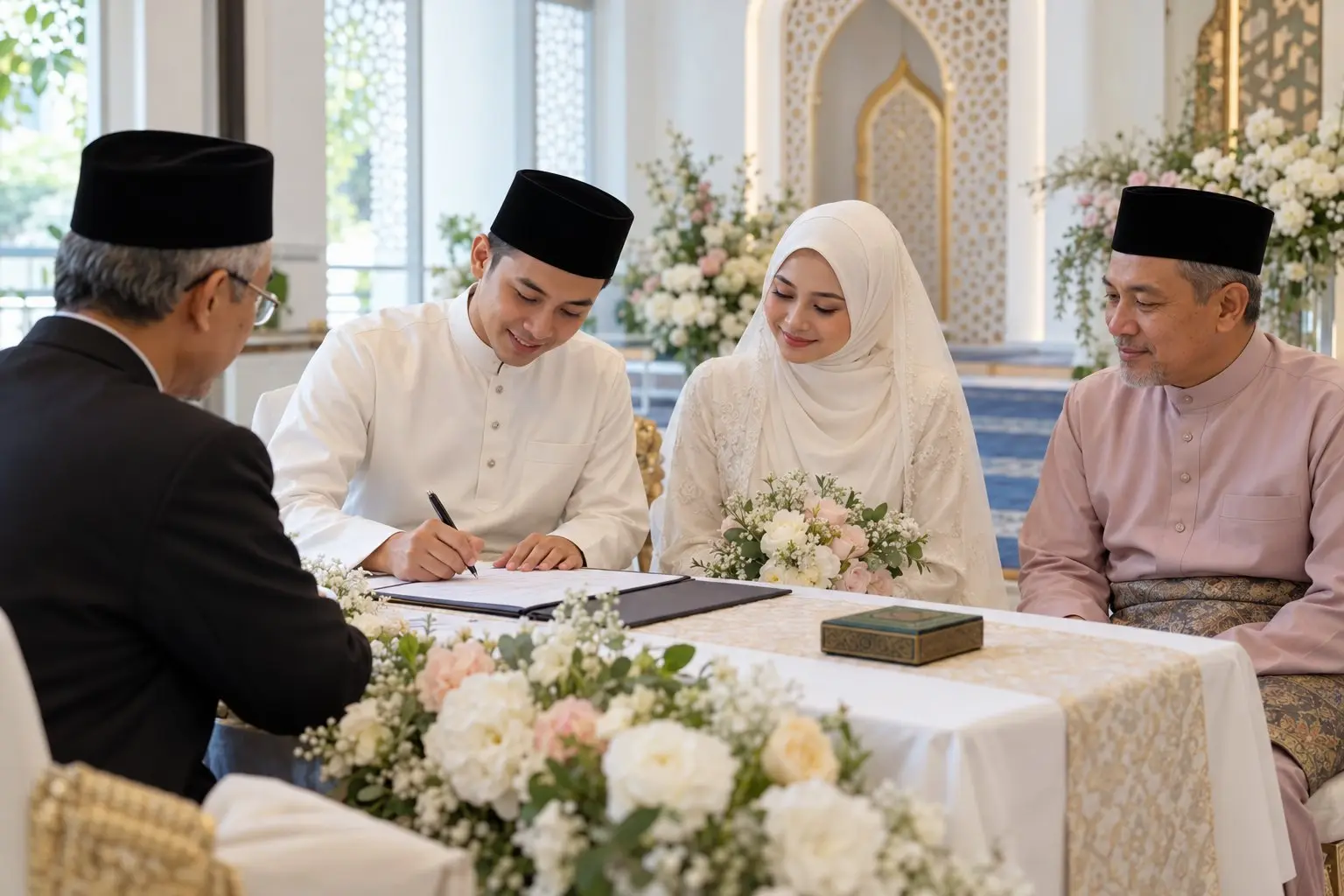
Muslim couples in Singapore register their marriage with the Registry of Muslim Marriages (ROMM), not ROM. Both must be Muslim and generally 21 or older, the bride's wali must consent, and the nikah and legal registration happen together in one seven-step process.
In Singapore, two Muslims marry through the Registry of Muslim Marriages (ROMM), not the civil Registry of Marriages (ROM). Under the Administration of Muslim Law Act (AMLA), the nikah and the legal registration happen together in a single, state-administered process led by a Kadi or Naib Kadi. This guide walks through who must use ROMM, eligibility, the wali, the seven steps, the documents, maskahwin, witnesses, fees, timelines and the special cases — following ROMM and MUIS. For festival context, see our Hari Raya Aidilfitri and Hari Raya Haji guides.
What ROMM is
ROMM registers Muslim marriages in Singapore and sits under MUIS. A marriage registered with ROMM is both a valid Islamic marriage and a legally recognised marriage under Singapore law — there is no separate civil ceremony. The standard process applies to couples who are both Muslim and 21 or older; couples where a party is under 21 follow a special route (below).
Who can marry under ROMM
To apply, both of you must meet ROMM’s eligibility:
- Both must be Muslims. A convert must first obtain a permanent conversion card from the Muslim Converts’ Association of Singapore (MCAS) for conversions in Singapore, or provide conversion documents and an endorsement letter from MUIS for overseas conversions.
- You must obtain consent from the bride’s wali or lawful guardian.
- You must both be at least 21 (standard process).
- Neither of you is currently married to anyone else or has an existing application with ROM or ROMM.
- Any previous marriage must be legally dissolved.
Divorcees intending to remarry must disclose any existing maintenance orders — including how promptly payments are made — as part of the statutory declarations.
The wali: the bride’s guardian
The wali is the bride’s lawful guardian, responsible for making sure the proposed groom is a reliable person who will take over his obligations toward the bride after marriage. To act as wali, a man must be a Muslim of sane mind who has reached puberty, be conceived after his parents’ lawful (Syariah) marriage, and not be an adopted child.
The wali’s responsibilities run through the whole process: give consent, provide his personal details for the application, attend the ROMM appointment and the solemnisation with original ID, and either conduct the akad nikah himself or authorise the Kadi/Naib Kadi to do it, then sign the marriage certificate.
The seven steps
ROMM’s process has seven steps:
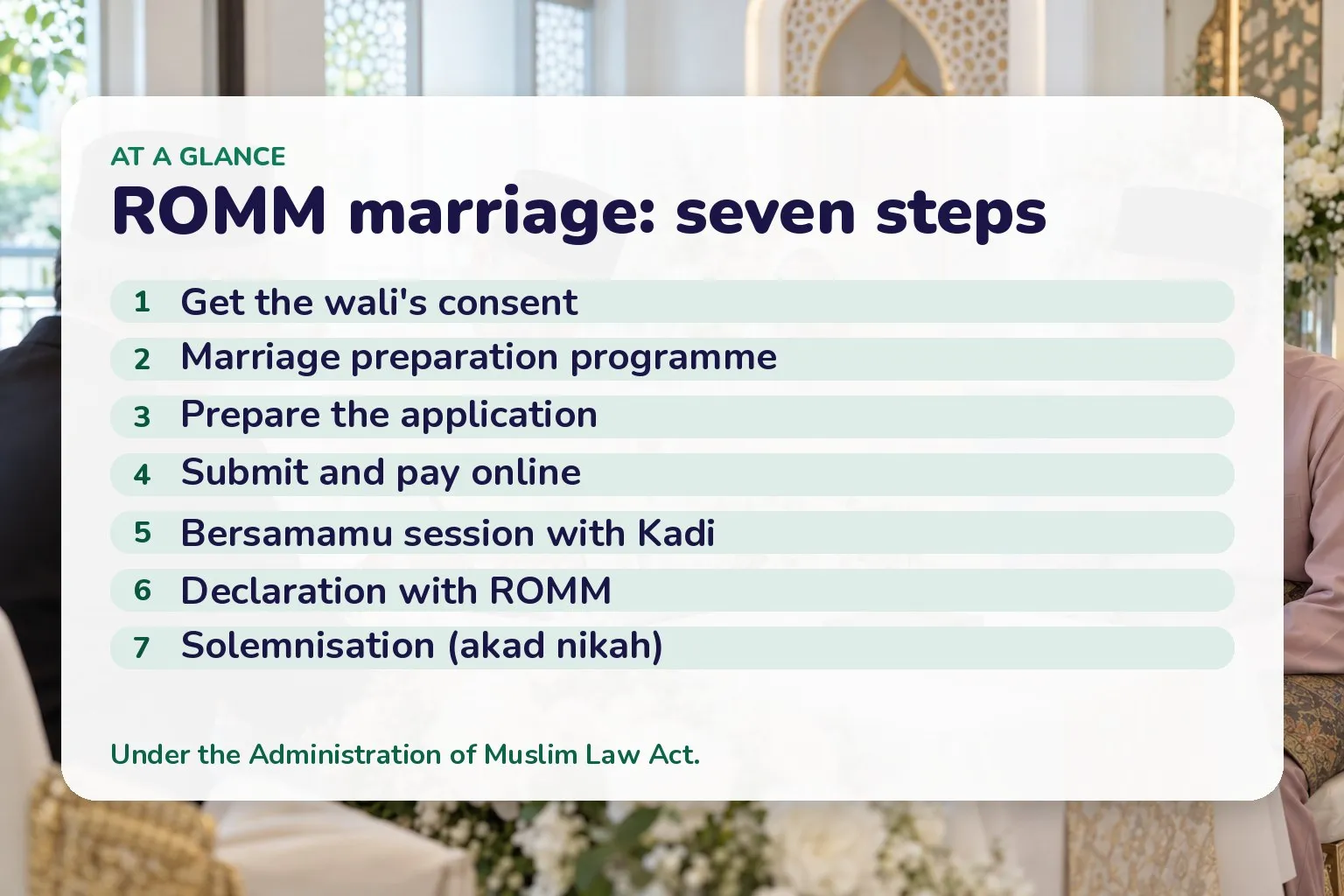
The ROMM Muslim marriage process end to end.
- Get the wali’s consent and explain his role.
- Prepare yourself for marriage — attend a marriage preparation programme and receive the certificate of completion (compulsory for couples under 21).
- Prepare your application — fix the solemnisation date, time and venue; choose your Kadi/Naib Kadi and two witnesses; and agree the maskahwin and hantaran.
- Submit the application online with Singpass and pay.
- Bersamamu Face-to-Face session with your Kadi/Naib Kadi — a session that also sets up their continued support for up to two years after the solemnisation. It must be completed before you make your declaration.
- Make a declaration with ROMM — by video link or in person to verify documents and declare under AMLA. Some couples qualify for online verification and declaration with no appointment.
- Solemnisation — the akad nikah, after which your marriage is registered and a digital certificate is emailed.
Documents to prepare
From November 2025, you must upload supporting documents with the application. Prepare:
- NRICs or passports for the bride, groom, wali, the bride’s biological mother, and the two witnesses.
- Birth certificates for the bride and groom.
- The bride’s biological parents’ marriage certificate.
- Solemnisation date, time and venue, plus the maskahwin and hantaran.
- A credit or debit card for payment.
If either of you was married before, add the death certificate and marriage certificate of the late spouse, or the divorce papers. Converts add the MCAS card (or MUIS endorsement). Documents not in English or Malay must be translated.
Maskahwin, hantaran and witnesses
The maskahwin (mahar) is a gift from the groom to the bride, given after the solemnisation. It may be cash or a token such as a ring or bracelet, and the current minimum rate in Singapore is S$100 cash. The couple may agree on any amount above this; it is the bride’s right.
The hantaran (marriage expenses) is an optional customary gift from the groom to the bride’s family, mutually discussed and agreed by both sides — it is a custom, not a legal requirement.
You also need two witnesses. Any male Muslim over 21 of any nationality qualifies — family or friends. Each must provide details, attend with original ID and sign the certificate.
Fees
| Situation | Fee (S$) |
|---|---|
| Either party is a citizen or PR | 39 |
| Both parties are foreigners | 128 |
| Change of solemnisation details (date/time/venue/witnesses) | 15 |
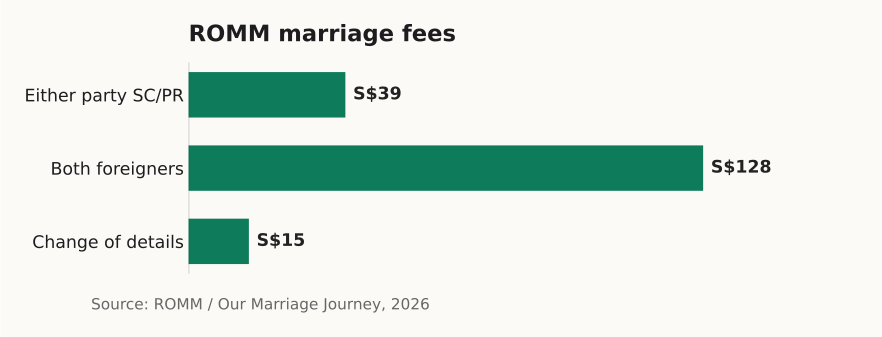
Official ROMM application fees.
Changes to solemnisation details can be made via e-Service up to 8 days before the solemnisation for the S$15 fee. Special cases may carry different charges, so confirm with ROMM if your situation is unusual.
Timelines and notice period
- The earliest solemnisation date is at least 21 days after you submit the application — ROMM requires 21 days’ notice.
- The application expires 150 days from submission; after that you must re-apply.
- Onsite solemnisation at ROMM runs Monday to Friday, excluding public holidays, with a maximum of 20 people including the couple and witnesses.
- Offsite solemnisation (home, a mosque, an outdoor venue) may be held any day of the week, including weekends and public holidays, subject to the Kadi/Naib Kadi’s availability.
The solemnisation (akad nikah)
On the day, the ceremony takes about 30 minutes and follows a set order:
- The Kadi/Naib Kadi checks the NRICs or passports of the bride, groom, wali and two witnesses.
- Both parties give verbal consent to the marriage.
- The Kadi gives a khutbah (sermon) on marriage.
- The wali conducts the akad nikah himself, or authorises the Kadi/Naib Kadi to do so.
- The groom reads the taklik — the special marriage conditions.
- The Kadi recites the doa (prayers).
- The groom gives the bride the maskahwin, and marriage gifts are exchanged.
Everyone needed must be present: bride, groom, wali, two witnesses and the Kadi/Naib Kadi (plus a certified interpreter if either party is not conversant in English or Malay). Dress appropriately — the Kadi may decline to proceed if attire is unsuitable. For offsite solemnisations an honorarium to the Kadi/Naib Kadi is expected; none is required if the solemnisation is at ROMM. Once registered, you receive a digital marriage certificate by email.
Special cases
- Under 21. If at least one party is 18 to below 21 at application, a special process applies (including a compulsory marriage preparation programme and parental/guardian consent). If the bride is below 18, a separate special process applies.
- Foreigners. A current or former Work Permit holder needs a marriage approval letter from MOM. A foreigner also needs a marital status letter from their home authority, valid no more than 90 days from issue. Malaysian, Indonesian or Bruneian citizens need a letter of recommendation from their local marriage registry or Islamic body.
- Converts. See the MCAS card / MUIS endorsement requirement above.
- Overseas marriages. ROMM cannot register a marriage solemnised and contracted outside Singapore; use the foreign certificate directly for your dealings here.
Polygynous marriage and revocation of divorce (rujuk) are separate special processes handled by ROMM; ask ROMM directly if either applies to you.
Frequently asked questions
Can two Muslims marry at ROM instead of ROMM? No. Under AMLA, Muslim marriages are registered with ROMM; the nikah and legal registration are one process.
How much notice do we need to give? At least 21 days between submitting the application and the solemnisation date.
What is the minimum maskahwin? S$100 cash is the current minimum; you may agree on more.
Do we need a religious conversion step? Only if one of you is a convert — then a permanent conversion card from MCAS (or a MUIS endorsement for overseas conversions) is required before applying.
How long is the application valid? 150 days from submission; after that you re-apply.
Sources
- Muslim marriage process — Registry of Muslim Marriages (ROMM) / Our Marriage Journey (as of October 2026)
- Get wali's consent — Registry of Muslim Marriages (ROMM) / Our Marriage Journey (as of October 2026)
- Prepare your marriage application (maskahwin, witnesses, Kadi) — Registry of Muslim Marriages (ROMM) / Our Marriage Journey (as of 24 February 2026)
- Submit marriage application (fees, documents, timeline) — Registry of Muslim Marriages (ROMM) / Our Marriage Journey (as of October 2026)
- Solemnisation (akad nikah) — Registry of Muslim Marriages (ROMM) / Our Marriage Journey (as of October 2026)
- Who can apply for a marriage with the Registry of Muslim Marriages? — Our Marriage Journey (ROM / ROMM) (as of October 2026)