What MUIS Halal Certification Actually Means
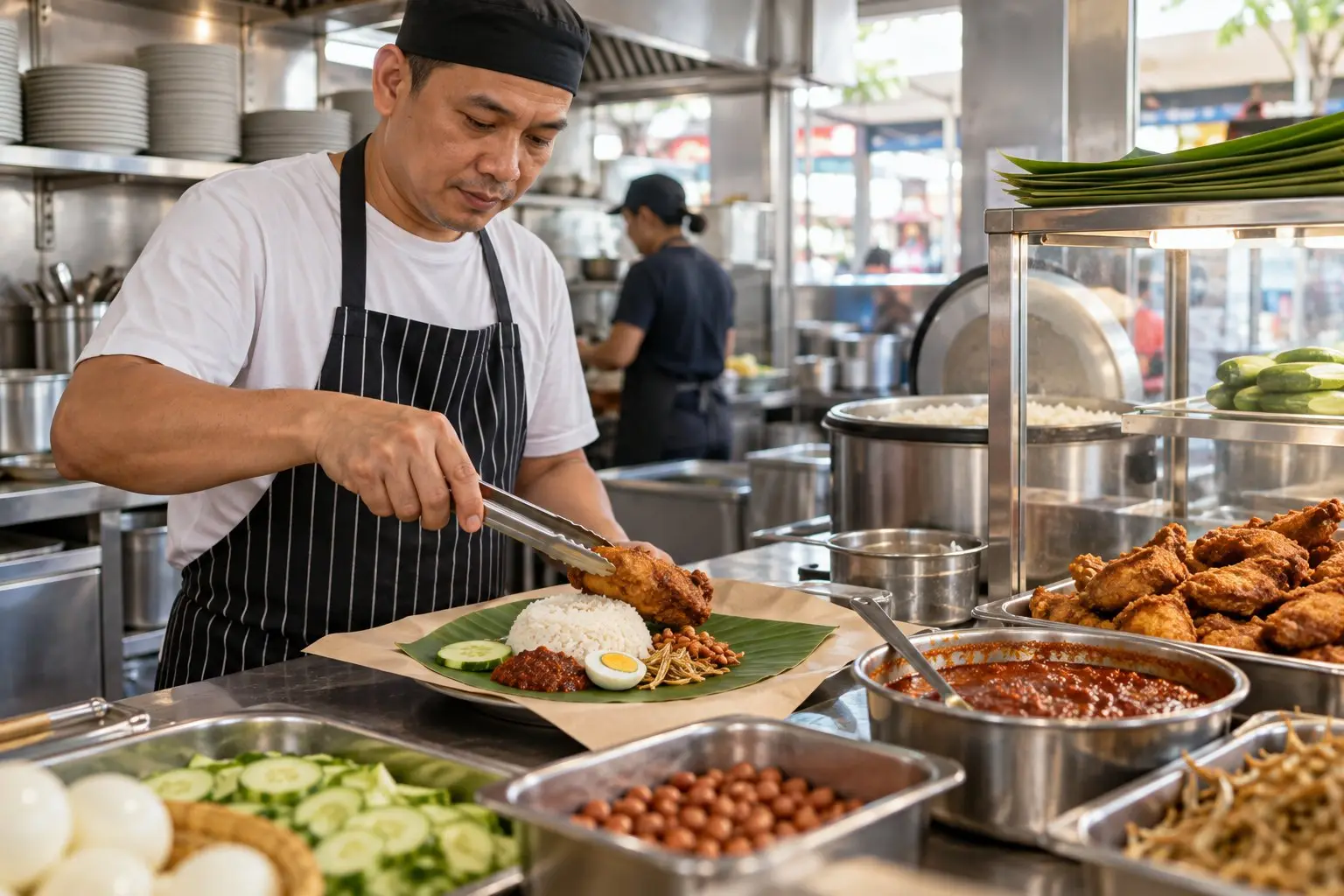
In Singapore, 'halal certified' means a food business or product holds a valid halal certificate. MUIS is the sole local halal certifier: it checks premises, processes, ingredients and supplier documentation against its Singapore MUIS Halal Standards before certifying. Products made overseas may instead carry MUIS-recognised foreign certification.
When a café or product in Singapore says it is “halal certified”, that has a precise meaning: it holds a valid halal certificate. MUIS (Majlis Ugama Islam Singapura) is the sole local authority that certifies halal in Singapore, and it both provides certification services and regulates the local halal industry. MUIS does not certify food products manufactured overseas: imported halal products are certified by Foreign Halal Certification Bodies (FHCBs) that MUIS recognises.
This page explains what the certificate actually covers. It is factual information about the certification system — not a religious ruling.
What MUIS checks before certifying
A halal certificate is not a label a business can print for itself. To be certified, a business is audited against the Singapore MUIS Halal Standards, covering:
- Ingredients — every ingredient must be halal and traceable.
- Suppliers — ingredients and suppliers must be declared and backed by the evidence MUIS asks for. Meat and relevant animal-derived imports generally need certification from a MUIS-recognised foreign body; other materials may need specifications, questionnaires, certificates or lab analysis.
- Preparation and handling — storage, equipment and processes must avoid cross-contamination with non-halal items.
- Premises and people — the physical set-up and staff practices are assessed.
The certificate is then issued under a specific scheme that matches the type of business.

Illustrative photo: certification looks at ingredients, suppliers, premises and processes, not just the menu.
The main certification schemes
| Scheme | Who it is for |
|---|---|
| Eating Establishment (EE) | Restaurants, cafés and food stalls, plus retail outlets such as bakeries, confectioneries and temporary bazaar stalls |
| Food Preparation Area (FPA) | Central kitchens, caterers and other food preparation areas |
| Product (PRO) / Whole Plant (WP) | Products made or processed in Singapore; or a whole manufacturing plant |
| Poultry Abattoir (PA) | Poultry slaughterhouses |
| Endorsement (EN) | A shipment-specific endorsement for already-certified products that are imported, exported or re-exported |
| Storage Facility (SF) | Facilities such as warehouses, cold rooms and dishwashing facilities, stationary or mobile |
Because the schemes differ, a certificate refers to what exactly is certified — for most schemes a specific outlet, kitchen, product or facility; the Endorsement scheme instead covers specific shipments of already-certified products.
A certificate is time-limited
A halal certificate must be kept current and renewed, and it can lapse or be withdrawn if standards are not maintained. Display rules depend on the scheme - eating establishments show the certificate at the outlet, while some other schemes have different rules. The reliable way to confirm current status is the official MUIS list of certified establishments: an outlet’s inclusion on the list indicates it is currently certified.
Certified is not the same as Muslim-owned
This is the most common point of confusion. A shop being Muslim-owned does not, by itself, make it “halal certified”. Only a valid MUIS certificate does. We explain the difference, and how to verify, in MUIS-certified vs Muslim-owned.
Related
- MUIS-certified vs Muslim-owned: the difference
- Search certified eateries with our tools
- How we research and update
Sources
- Halal — guide to halal and halal certification in Singapore — Majlis Ugama Islam Singapura (MUIS) (as of October 2026)
- Scheme types & eligibility criteria — Majlis Ugama Islam Singapura (MUIS) (as of September 2026)
- Singapore Halal Certification process — Majlis Ugama Islam Singapura (MUIS) (as of October 2026)
- Foreign Halal Certification Bodies (FHCB) — Majlis Ugama Islam Singapura (MUIS) (as of October 2026)